

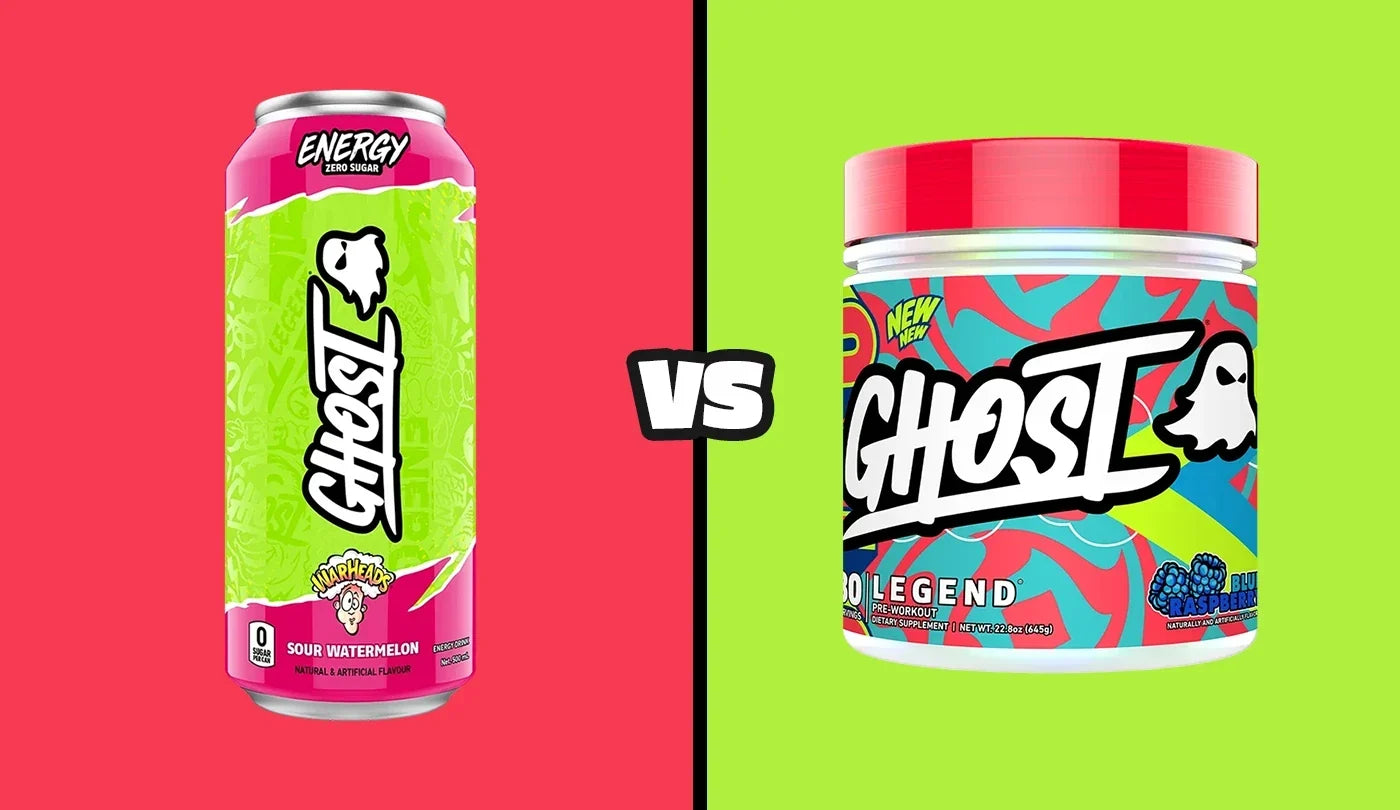
Walk into any gym in New Zealand and you'll see both sitting in gym bags — a shaker of pre-workout powder and a cold can of energy drink. They look like they do the same job. They're both driven by caffeine, both promise energy and focus, and both get consumed in that same twenty-minute window before training starts.
But the pre workout vs energy drink question has a genuine answer, and it isn't "whichever you prefer." These are two different products built for two different purposes, and picking the wrong one means either paying for ingredients you don't need or missing out on the ones you do. Here's how to work out which belongs in your routine.
The Short Answer
A pre-workout is a training tool. It's built to improve what happens between your first rep and your last — strength output, muscular endurance, blood flow and focus under load. The caffeine is only one part of the formula.
An energy drink is a convenience product. It delivers alertness and focus in a ready-to-drink can, with a much lighter performance profile behind the caffeine. It's designed for your day, not specifically for your session.
If you're training hard and want measurably better sessions, take the powder. If you want a lift for work, study, cardio or a casual gym visit, grab the can. Most people who train seriously end up using both, which we'll get to.
What's Actually in Each One
Inside a pre-workout
A quality pre-workout is a stacked formula, and the caffeine is arguably the least interesting part of it. Take Nexus PER4M, which is consistently one of our strongest performers. A full serve delivers 16 g of active ingredients across 17 components — including 6,000 mg of L-Citrulline for blood flow and pumps, 3,200 mg of Beta-Alanine for muscular endurance, and 1 g of Taurine, alongside a moderate, well-judged caffeine dose.
Those numbers matter. The clinical research on citrulline and beta-alanine points to doses in exactly that range — 6 g and 3.2 g respectively. PER4M isn't sprinkling in a token amount so it can appear on the label. It's dosing to the research, which is why it works session after session rather than just feeling strong the first time you try it.
That's the core distinction. Pre-workouts contain performance ingredients at doses that actually do something.
Inside an energy drink
A modern energy drink is a cleaner, lighter formula built around alertness. Ghost Energy — comfortably our best-selling can — packs 160 mg of naturally sourced caffeine into a 473 ml can with zero sugar and five calories, supported by NeuroFactor coffee fruit extract, taurine, alpha-GPC and L-carnitine.
That's a genuinely good formula, and Ghost's full-disclosure label means you can see every dose. But notice what it's optimising for: smooth mental energy and focus. There's no 6 g of citrulline in there, because there's no room for it in a 473 ml can and it isn't what the product is for.
The trade-off is convenience. No scoop, no shaker, no mixing, no washing up. The dose is identical every single time, and it's cold.
How Much Caffeine Is in Pre-Workout vs an Energy Drink?
This is where the two categories separate most clearly. Energy drinks cluster in a fairly narrow band. Pre-workouts scale enormously.
| Product | Type | Caffeine per serve |
|---|---|---|
| Bucked Up Energy | Energy drink | 105 mg |
| Alani Nu Energy | Energy drink | 110 mg |
| Ghost Energy 250 ml | Energy drink | 80 mg |
| RYSE Fuel | Energy drink | 150 mg |
| Ghost Energy | Energy drink | 160 mg |
| C4 Original | Pre-workout | 200 mg |
| Ghost Legend V4 | Pre-workout | 300 mg |
| Nexus PER4M 2.0 | Pre-workout | 500 mg |
Energy drinks sit between roughly 80 mg and 160 mg. Pre-workouts start where energy drinks finish and climb from there.
A word of caution on the top end. Nexus PER4M 2.0 delivers 500 mg of caffeine in a full serve, alongside 10,000 mg of Citrulline Malate and 5,000 mg of Beta-Alanine. That is a serious product built for experienced, stimulant-tolerant lifters — and it sits above the 400 mg daily figure that health authorities generally cite as the upper limit for healthy adults. If you're going anywhere near it, start on a half serve and account for every other caffeine source in your day. It is emphatically not a beginner's product.
For most people, the original PER4M is the smarter choice. You get the full clinical doses of the performance ingredients without the stimulant load that keeps you staring at the ceiling at midnight.
Head to Head: The Practical Differences
| Pre-Workout | Energy Drink | |
|---|---|---|
| Built for | Training performance | General energy and focus |
| Caffeine range | 150–500 mg | 80–160 mg |
| Pump ingredients | Clinical doses of citrulline | Minimal or none |
| Endurance support | Full beta-alanine doses | Usually absent |
| Dose control | Adjustable by scoop | Fixed per can |
| Convenience | Requires mixing | Open and drink |
| Cost per serve | Generally lower | Generally higher |
| Best used | 20–30 min pre-training | Anytime you need a lift |
When to Choose a Pre-Workout
Reach for the powder when the session actually matters.
You're training for strength or hypertrophy
Heavy compound work, progressive overload, chasing personal bests — this is where the citrulline and beta-alanine earn their place. Better blood flow and delayed muscular fatigue translate into more quality reps, and more quality reps over months is what drives progress. A can simply doesn't carry these ingredients in meaningful amounts.
You want to control your own dose
The scoop is a genuine advantage. New to stimulants? Start with half. Training in the evening? Half again. Big session on a Saturday morning? Full serve. A can gives you one option, every time. Our guide to the top 5 pre-workout supplements in NZ for 2026 walks through which formulas suit which tolerance level.
You're training frequently
If you're in the gym four, five or six days a week, powder is the more economical option per serve by a comfortable margin. That gap compounds fast over a year.
Where to start
For most people, Nexus PER4M is the sweet spot — clinically dosed across pumps, endurance and focus, with energy that's noticeable without being overwhelming. It's the one we recommend most often for daily training.
If you want a fully transparent label and a stronger stimulant hit, Ghost Legend V4 brings 300 mg of natural caffeine with L-Citrulline and Nitrosigine. Newer lifters or anyone caffeine-sensitive should look at C4 Original, which is the most accessible entry point on our shelves. Experienced lifters chasing raw intensity tend to gravitate toward Inspired Big Black DVST8. Browse the complete pre-workout range to compare.
When to Choose an Energy Drink
Grab the can when the caffeine is the point and the performance ingredients aren't.
You need energy outside the gym
Work, study, night shifts, long drives, gaming. A pre-workout's citrulline and beta-alanine do nothing useful at your desk — you're paying for ingredients you can't use. This is what cans are actually for.
Convenience genuinely matters
Training straight after work with no shaker on you? A can in the gym bag solves it. Ghost Energy at 160 mg sits right at the top of the energy drink range and lands close to a moderate pre-workout dose, which is why so many people use it exactly this way.
You're doing lighter or cardio-based training
A run, a cycle, a moderate conditioning session — you don't need 6 g of citrulline for that. Caffeine alone does most of the useful work.
Your caffeine tolerance is low
This is where cans have a real edge. The Ghost Energy 250 ml at 80 mg or Bucked Up Energy at 105 mg give you a controlled, modest dose. Alani Nu at 110 mg includes L-theanine, which pairs with caffeine to smooth out jitteriness. For sustained focus without intensity, RYSE Fuel at 150 mg is a solid pick. See our full ranking of the best energy drinks available in New Zealand for the complete breakdown, or browse the energy drinks collection.
Can You Use Both?
Yes — and most regular gym-goers do. The sensible pattern looks like this:
- Powder on heavy training days. Legs, big compound sessions, anything where you're chasing progression. This is where full doses pay off.
- Cans on lighter days and non-training days. Cardio, active recovery, or just a mid-morning lift at the desk.
- Never both in the same window. Stacking a 300 mg pre-workout with a 160 mg can puts you at 460 mg in one sitting. That's a fast track to a racing heart, anxiety and a wrecked night's sleep.
Cellucor is a useful illustration here — C4 Original for training days and C4 Energy Carbonated for everything else, same brand, two clearly different jobs.
Caffeine, Timing and Safety
Health authorities generally consider up to 400 mg of caffeine per day safe for most healthy adults. Pregnant women are typically advised to stay under 200 mg, and neither product is suitable for anyone under 18.
Count everything. Your morning coffee is roughly 80–100 mg. Add a 300 mg pre-workout and you've already hit 400 mg before lunch. Fat burners frequently contain caffeine too, and stacking them with a pre-workout is a common and avoidable mistake.
Timing matters just as much as dose. Caffeine has a half-life of around five to six hours, so half of a 300 mg pre-workout is still circulating at bedtime if you took it at 5 pm. If you train in the evening, a stim-free pre-workout gives you the pumps and endurance ingredients with none of the stimulant — our guide to the best stim-free options covers this properly. Sleep is where adaptation actually happens, so protecting it is a performance decision, not a soft one. Our sleep supplement guide covers the other half of that equation.
One last thing: caffeine is mildly diuretic and neither product replaces proper hydration. If you're training in warm conditions, pair either with something from our electrolytes and hydration range.
The Verdict
They're not competitors. They're different tools.
If you train seriously and want your sessions to improve, buy a pre-workout — Nexus PER4M is where we'd point most people, because it's clinically dosed where it counts without going overboard on stimulants.
If you want reliable, convenient energy for training and everything else in your day, buy cans — and Ghost Energy remains the one our customers come back for, on formulation, transparency and flavour.
Plenty of people keep both on hand, and that's the honest answer for most regular gym-goers. Explore the full energy and endurance range to build out whichever approach suits your training.
Leave a comment
All comments are moderated before being published.
This site is protected by hCaptcha and the hCaptcha Privacy Policy and Terms of Service apply.